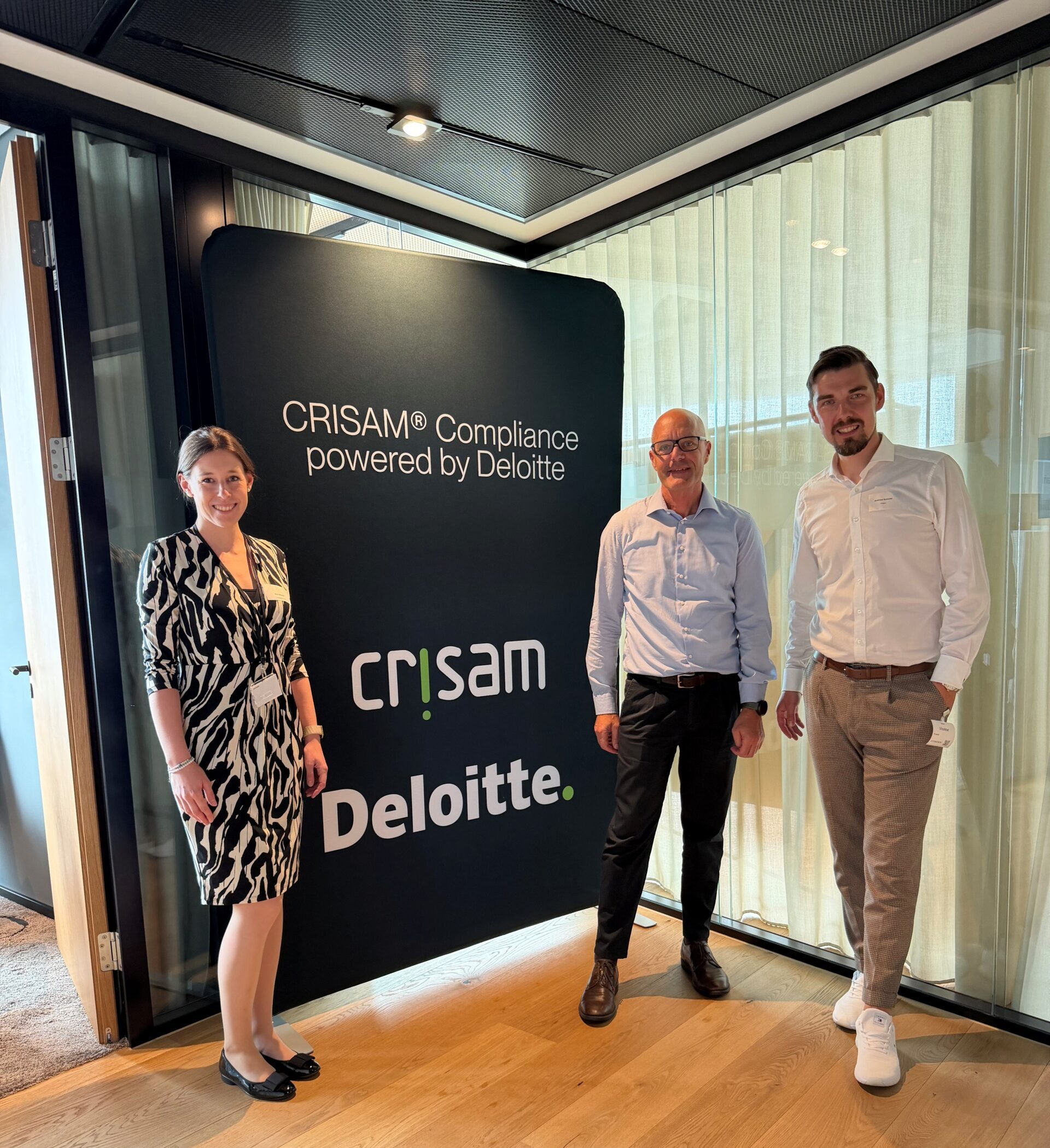
CRISAM® at Deloitte Tax CMS Day 2026: Discover how companies can move from GoBD documentation to an effective Tax Compliance Management System.
Düsseldorf, July 2026: Taxes are no longer just a matter of filing returns. They are an organizational, process, and risk issue. Companies that want to meet their tax obligations reliably need more than technical expertise in the tax department. They need clear processes, traceable responsibilities, effective controls, and documentation that holds up in an audit.
This is where the journey begins: from the mandatory GoBD process documentation to a modern Tax Compliance Management System (Tax CMS), and on to a tax control system that not only brings structure to a company but can also reduce its liability exposure.
The starting point: GoBD and process documentation
The GoBD (the German principles for the proper keeping and retention of books, records, and documents in electronic form) define how electronic books, records, and documents must be kept, retained, and made available for data access by the tax authorities. For companies, this means that tax-relevant processes must be traceable, verifiable, and documented.
Process documentation describes how data is created, processed, checked, stored, and archived. That makes it a key building block of tax compliance. But it does not automatically answer the crucial question: Are tax risks actually identified, assessed, managed, and controlled in day-to-day operations?
This is exactly where purely descriptive documentation falls short. Companies need a system that not only explains how processes are supposed to work, but shows that they actually do.

From documentation to management: what a Tax CMS delivers
A Tax CMS brings tax obligations, risks, processes, controls, responsibilities, and evidence together in one structured system. It shows where tax risks can arise, for example in VAT, payroll tax, transfer pricing documentation, withholding tax, income tax, or cross-border transactions.
The key difference from documentation alone is effectiveness. A Tax CMS is not a digital filing cabinet. It is a management tool. It assigns responsibilities, defines controls, documents how they are performed, flags deviations, and creates a solid basis for internal and external audits.
This makes tax compliance operational. Individual measures become a traceable control system. Scattered Excel lists, process descriptions, and email evidence become an integrated management approach.

Why a Tax CMS matters
for companies
An effective Tax CMS helps companies detect tax errors earlier, reduce risks systematically, and assign clear responsibilities. This is especially important because tax errors can have more than financial consequences. They can damage a company’s reputation and raise personal liability issues for executives and other responsible individuals.
This is not about the illusion of zero errors. No system can prevent every deviation. What matters is whether a company can demonstrate that it has taken appropriate organizational measures to meet its tax obligations properly.
A Tax CMS that is put into practice shows that tax compliance is not left to chance. It is organized, documented, verifiable, and continuously improved.

The next step: the tax control system as a safeguard
With the tax control system (in German “Steuerkontrollsystem,” or SKS), the focus on effectiveness becomes even more important. The administrative guidance on Section 153 of the German Fiscal Code (AO) states that an internal control system designed to ensure compliance with tax obligations can be an indication against intent or recklessness. This does not mean an automatic release from liability. But it sends an important signal: A company that organizes its tax obligations in a structured way, controls risks, and manages error processes transparently is in a different position if something goes wrong than a company without a robust control system.
Article 97 Section 38 of the Introductory Act to the German Fiscal Code (EGAO) also clearly reflects this development. It describes the tax control system as the entirety of internal measures intended to ensure that the tax bases are correctly recorded and taken into account and that taxes are paid in full and on time. The system must also map tax risks on an ongoing basis.
This shifts the focus away from one-off reviews and after-the-fact error correction toward ongoing management, transparency, and demonstrable effectiveness.

Why the CRISAM® x Deloitte Standard creates value
This is exactly where the CRISAM® x Deloitte Standard comes in. It combines the technological strength of the CRISAM® GRC platform with Deloitte’s tax and compliance expertise. The result is a practical approach that does not stop at the design stage but supports implementation in day-to-day operations.
CRISAM® provides the structure, workflows, dashboards, risk control matrices, task management, evidence documentation, and reporting capabilities. Deloitte contributes methodological experience, in-depth tax expertise, and field-tested content. Together, they create a standard that helps companies not just describe tax compliance, but run it effectively.
The main advantage lies in combining content and system. Risks, controls, and measures are not managed in isolation but brought together in one integrated platform. Owners can see which controls are due, which evidence is missing, where risks are increasing, and which topics need management attention.
This turns a Tax CMS into a tax control system that can be managed, audited, and scaled.

For large corporations and mid-sized companies alike
A common misconception is that a Tax CMS is only relevant for large corporations. In fact, companies of all sizes benefit. Large groups need a system to keep complexity, entity structures, countries, tax types, and reporting obligations under control. Mid-sized companies benefit especially from clear responsibilities, simple workflows, and structured evidence management.
Small and mid-sized companies in particular often face the challenge that tax knowledge rests with just a few people. When processes are not documented, controls happen only informally, and evidence sits in emails or local files, significant organizational risk arises. A Tax CMS creates transparency, repeatability, and confidence.
The solution does not have to be oversized. A good standard is scalable. It grows with the organization, adapts to the size of the company, and allows a pragmatic start, from core tax processes all the way to a comprehensive tax control system.

Conclusion: Tax CMS is not a project, but a level of maturity
The path from GoBD process documentation to a Tax CMS and on to a tax control system is more than a regulatory development. It reflects a new understanding of tax governance.
Companies that invest in an effective Tax CMS today are not just bringing order to their documentation. They are creating transparency about risks, reliability in processes, relief for those responsible, and a stronger position with auditors and authorities.
The CRISAM® x Deloitte Standard offers a practical way to get there: grounded in expertise, supported by technology, and scalable for companies of any size.
The key message: Tax compliance must not end up in a filing cabinet. It has to make a difference across the organization.

Let’s keep the conversation going
The Tax CMS Day in Düsseldorf showed how companies can move from documentation to an effective tax control system. The real value, however, comes when these possibilities meet your specific situation.
Curious how the CRISAM® x Deloitte Standard can make tax compliance in your organization more transparent, verifiable, and efficient? Talk to our team. We’ll be glad to show you how the standard works in practice and how it applies to your processes.

Would you like to get to know us?
Discover our CRISAM® / AWADO
on-site training
The CRISAM® / AWADO on-site training at the GenoHotel Baunatal offers hands-on expertise in building and running an ISMS or IRM, taught by experienced practitioners. Seats are limited, so reserve yours now and strengthen your risk management.