Crisam Logo
  • CRISAM®
    CRISAM®
    • What is CRISAM®?
    • Method
    • Content
    • Customers
    • Academy
    • Webinars
    • Events
  • Areas of application
    Areas of application
    • Information Security Management
    • Integrated Risk Management
    • ESG
    • CRISAM® AI
    • Data Protection Management
    • Audit Management
    • Compliance Management
    • Business Continuity Management
    • Tax Compliance Management System
    • Project Risk Management
    • Legal Register
    • Conflicts of Interest Software
    • CRISAM® Legal Hold Software
  • Industries
    Industries
    • Automotive
    • Energy
    • Manufacturing
    • Financial Services
    • Retail
    • Real Estate & Construction
    • Healthcare
    • Broadcasting & Telecommunications
    • Technology
    • Transport & Logistics
  • More
    More
    • Download Center
    • CRISAM® Academy
    • Webinars
    • News
    • Review CRISAM®
    • Jobs
    • CRISAM® Partners
    • Trust Center
    • Contact
  • en
    • de
Request
  • Sprache
    • en-gb
    • de
  • CRISAM®
    • What is CRISAM®?
    • Method
    • Content
    • Customers
    • Academy
    • Webinars
    • Events
  • Areas of application
    • Information Security Management
    • Integrated Risk Management
    • ESG
    • CRISAM® AI
    • Data Protection Management
    • Audit Management
    • Compliance Management
    • Business Continuity Management
    • Tax Compliance Management System
    • Project Risk Management
    • Legal Register
    • Conflicts of Interest Software
    • CRISAM® Legal Hold Software
  • Industries
    • Automotive
    • Energy
    • Manufacturing
    • Financial Services
    • Retail
    • Real Estate & Construction
    • Healthcare
    • Broadcasting & Telecommunications
    • Technology
    • Transport & Logistics
  • More
    • Download Center
    • CRISAM® Academy
    • Webinars
    • News
    • Review CRISAM®
    • Jobs
    • CRISAM® Partners
    • Trust Center
    • Contact
  • Request
Home/News/AI Act postponed

AI Act postponed: why your AI inventory still matters now

Regulation (EU) 2026/1744 gives organisations more time for high-risk AI systems. What changes, which deadline still ends in December 2026, and why role, risk class and obligations per system remain the foundation.

Linz, November 2026Reading time approx. 7 minutes
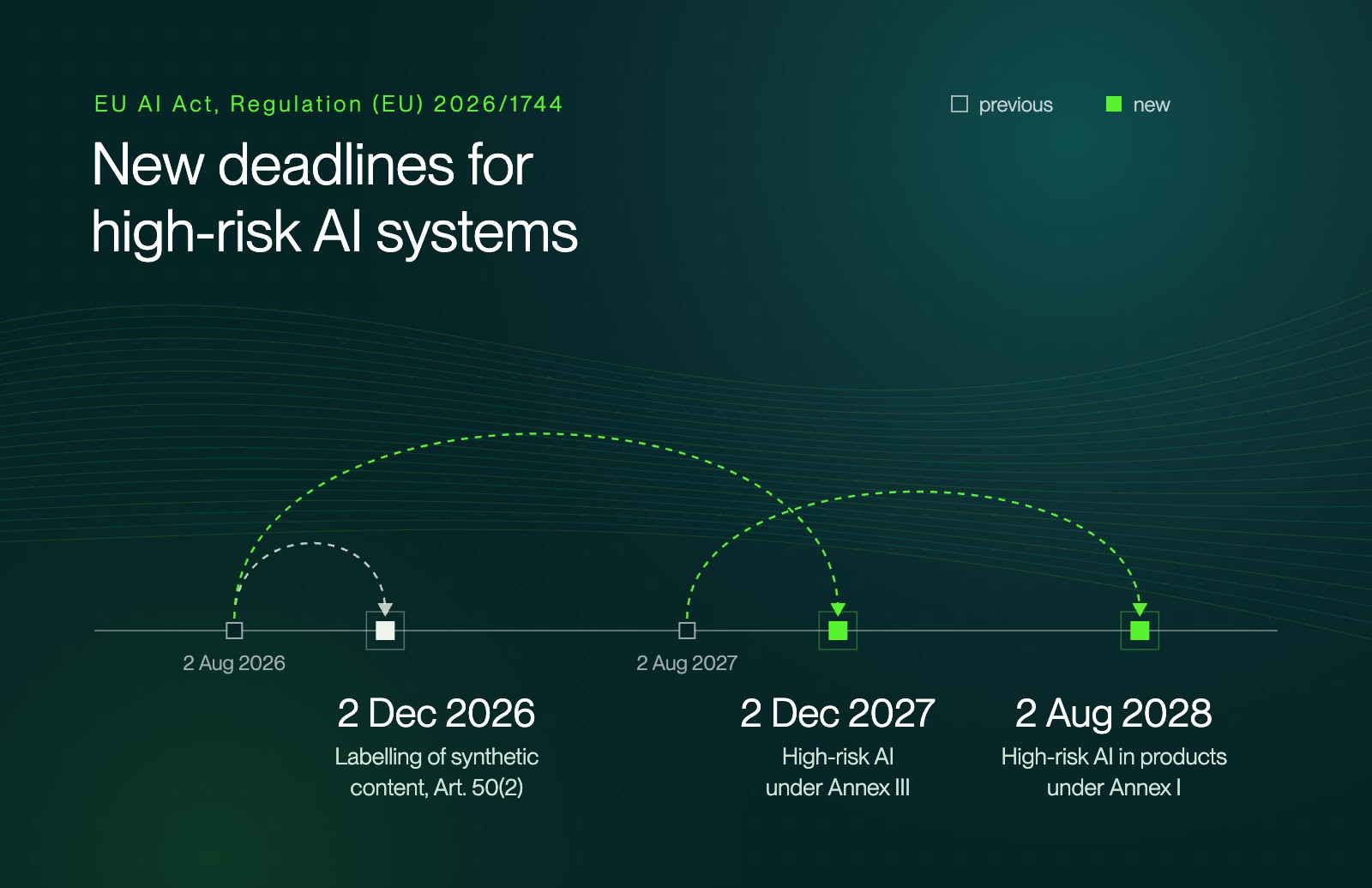
Timeline of the new EU AI Act deadlines: 2 December 2026, 2 December 2027 and 2 August 2028
Contents
  1. What changes
  2. Why act now
  3. Four steps
  4. How CRISAM® helps
  5. FAQ
  6. Next step
Share this article
LinkedIn
In brief

Regulation (EU) 2026/1744, the Digital Omnibus on AI, postpones the obligations for high-risk AI systems under the EU AI Act: to 2 December 2027 for systems under Annex III and to 2 August 2028 for systems under Annex I. Other deadlines end sooner, such as the transition period for AI systems already on the market that generate synthetic content, on 2 December 2026. The extra time only helps if you know which AI systems are in use, in which role and with which risk class. CRISAM® keeps this AI inventory with classification, obligations and evidence in one place.

Since 27 July 2026, a new timetable applies to the EU AI Act. For many organisations this sounds like relief. But the postponement covers only part of the obligations, and it does not change the question every implementation has to answer first: which AI systems do you use, and what follows from that?

What does the Digital Omnibus change in the AI Act?

Regulation (EU) 2026/1744 amends Regulation (EU) 2024/1689, the EU AI Act. Above all, it postpones the date from which the requirements for high-risk AI systems apply. The reason given is the lack of harmonised standards, guidelines and competent authorities.

ObligationPreviouslyNew
High-risk AI systems under Annex IIIArticle 6(2), for example employment, creditworthiness, critical infrastructure2 August 20262 December 2027
High-risk AI in products under Annex IArticle 6(1), products with a safety component2 August 20272 August 2028
Labelling of synthetic contentArticle 50(2), transition period for providers of AI systems that generate synthetic content and were placed on the market before 2 August 20262 August 20262 December 2026

For high-risk systems already placed on the market before the relevant date, Article 111(2) as amended contains a transitional rule: the requirements generally only apply if their design is significantly changed afterwards. This is not a blanket exemption. Whether a system is covered depends on when it was placed on the market and on the specific change, and has to be assessed per system. Certain systems of public authorities are subject to their own transitional rules.

Regulation (EU) 2026/1744 at a glance
Name
Digital Omnibus on AI
Amends
Regulation (EU) 2024/1689 (EU AI Act)
Date
8 July 2026
Official Journal
24 July 2026
In force
27 July 2026
Applies
directly in all EU Member States

Source: EUR-Lex, Regulation (EU) 2026/1744

Why is more time no reason to wait?

Three dates and developments show that implementation is already under way:

  • 2.12.2026Transition period under Article 50(2) ends for systems already on the market that generate synthetic content
  • EN 18286First harmonised standard under the AI Act, for the quality management system under Article 17
  • since 2.2.2025General provisions and the prohibitions under Article 5 apply

The obligations for high-risk systems come later, but they are coming. Whether a system falls under Annex III can only be judged once it has been recorded. If you know your AI systems, you can prioritise. If you do not, you start from zero in 2027.

Then there is the transitional rule for existing systems under Article 111(2). Whether a system is covered is a case-by-case assessment: what matters is when it was placed on the market and whether a later change significantly alters its design. Both can only be evidenced against a documented baseline.

Standardisation has also moved on. With Implementing Decision (EU) 2026/2274, EN 18286:2026 is the first harmonised standard under the AI Act. It describes the quality management system that Article 17 requires from providers of high-risk AI systems. If you build your quality management on it, you can rely on the presumption of conformity for this part. Informative annexes map the standard to EN ISO 9001 and EN ISO/IEC 42001. The standard does not, however, cover all requirements for high-risk AI: it replaces neither the conformity assessment nor the other obligations of the AI Act.

  • Regulation (EU) 2024/1689
  • Regulation (EU) 2026/1744
  • EN 18286:2026
  • ISO/IEC 42001
  • ISO 9001

More time does not replace an AI inventory. Role, risk class and obligations per system remain the foundation.

How should you proceed? Four steps

  1. Record

    Capture all AI systems and AI functions in applications, IT systems and cloud services: where they run, who is responsible and which data they process.

  2. Classify

    Check for each system whether it is an AI system as defined by the AI Act, whether a prohibited practice applies and which risk class it falls into. Record the classification with its reasoning.

  3. Assign obligations

    Clarify the role, provider or deployer, often both. This determines the obligations per system, from transparency under Article 50 to the requirements for high-risk systems.

  4. Keep the evidence

    Track open items as measures with a deadline and an owner. Document approvals and assessments so that the current status can be shown at any time.

How CRISAM® helps

In the CRISAM® AI Management System, AI systems are managed as objects of their own, not as rows in a list. The evidence is created during day-to-day operation:

  1. 01Central inventory of all AI systems and AI products with owners, approval and status
  2. 02Quick check against the AI Act definition and classification under the EU AI Act, including a check for prohibited practices
  3. 03Provider and deployer obligations held separately, high-risk systems with their own question set
  4. 04Measures with deadlines and owners, approval as a step in the workflow
  5. 05Dashboard, report and detail view per system, documented in an audit-proof way
  6. 06Links to ISMS, data protection management, risk register and internal control system

The AI Act does not become a separate topic. It runs in the same model as information security and data protection.

Would you like to see what an AI inventory with classification and evidence looks like in practice?

EU AI Act in CRISAM®Talk to our team

FAQ on the AI Act postponement

  • For high-risk AI systems under Article 6(2) and Annex III, the requirements apply from 2 December 2027. For high-risk AI under Article 6(1) and Annex I, that is in regulated products, from 2 August 2028. This is set out in Regulation (EU) 2026/1744.

  • The transition period for certain providers of AI systems already on the market that generate synthetic content and were placed on the market before 2 August 2026. They must meet the relevant labelling obligations under Article 50(2) by 2 December 2026.

  • Not across the board. Article 111(2) contains a transitional rule for high-risk systems placed on the market before the relevant date: the requirements generally only apply once their design is significantly changed. Whether this is the case depends on when the system was placed on the market and on the specific change, and has to be assessed per system. Certain systems of public authorities are subject to their own transitional rules.

  • EN 18286:2026 is the first harmonised standard under the AI Act, cited through Implementing Decision (EU) 2026/2274. It sets requirements for the quality management system of providers of high-risk AI systems under Article 17. It was developed by CEN-CENELEC JTC 21. The standard covers only this part and replaces neither the conformity assessment nor the other requirements of the AI Act.

  • No. Like the AI Act itself, Regulation (EU) 2026/1744 applies directly in all Member States. It entered into force on 27 July 2026.

Next step: webinar on the EU AI Act

Stay in control of AI compliance and the EU AI Act

3 December 2026, 1:00 pm, online, 45 minutes. How to record AI applications in CRISAM®, assess their risks and document the requirements. Further dates from 17 December 2026 to 25 March 2027.
Register here
Published in NewsBack to overview

More news

View all news

That was #RISK 2026: AI governance at machine speed

#RISK Expo Europe 2026 recap: two days at ExCeL London, one panel, one question at our stand, and why AI governance ran through all of it.

Read more

Beyond Basel at #RISK London: governing AI at machine speed

Beyond Basel at #RISK London: why AI governance must run at machine speed, plus five board questions. Read now.

Read more

CRISAM® at FERMA Forum 2026: From risk insight to strategic foresight

What FERMA Forum 2026 showed about strategic foresight and why integrated GRC provides the foundation for it.

Read more

Let's stay in touch

Subscribe to the newsletter
Phone+43 732 601 216-0
Emailoffice@crisam.net
CRISAM GRC Software
Darstellung eines Trends im Risikomanagement

CALPANA business consulting GmbH

Blumauerstr. 45-47

4020 Linz, Austria

+43 732 601 216-0 sales@crisam.net

CALPANA business consulting Deutschland GmbH

Paul-Dessau-Str. 1

22761 Hamburg, Germany

+49 (40) 35 98 29 21 sales@crisam.net

CALPANA business consulting GmbH

Blumauerstr. 45-47

4020 Linz, Austria

+43 732 601 216-0 sales@crisam.net

CALPANA business consulting Deutschland GmbH

Paul-Dessau-Str. 1

22761 Hamburg, Germany

+49 (40) 35 98 29 21 sales@crisam.net
CRISAM®
  • What is CRISAM?
  • CRISAM® Method
  • CRISAM® Content
  • Customers
  • Academy
  • Webinars
  • Events
  • CRISAM® Academy
Operational area
  • Integrated Risk Management
  • Information Security Management
  • CRISAM® AI
  • ESG
  • Data Protection Management
  • Audit Management
  • Compliance Management
  • Business Continuity Management
  • Tax Compliance Management System
  • Project Risk Management
  • Legal Register
  • Conflicts of Interest Software
  • CRISAM® Legal Hold Software
Industries
  • Automotive
  • Energy
  • Manufacturing
  • Financial Services
  • Healthcare
  • Retail
  • Real Estate & Construction
  • Broadcasting & Telecommunications
  • Technology
  • Transport & Logistics
More
  • Download Center
  • CRISAM® Academy
  • Webinars
  • CRISAM® Partners
  • Jobs
  • News
  • Trust Center
  • Contact

© 2026 CALPANA business consulting GmbH. All rights reserved.

  • Imprint
  • Privacy
  • Trustcenter
linkedin
xing
Chartis Research Category LeaderChartis RiskTech Quadrant® für GRC Analytics 2025

Die Anmeldung schließen Sie auf der nächsten Seite ab. Abmeldung jederzeit möglich.

Bitte geben Sie eine gültige E-Mail-Adresse ein.

Lösungen

  • Risikomanagement
  • Information & Cyber Security (ISMS)
  • Internes Kontrollsystem
  • Compliance Management
  • Alle Lösungen

Plattform

  • Plattform im Überblick
  • CRISAM® AI
  • Reporting
  • Normen und Standards

Ressourcen

  • Success Stories
  • News
  • Webinare
  • Events
  • Karriere

Kontakt

  • Österreich+43 732 601 216-0
  • Deutschland+49 40 35 98 29 21
  • E-Mailoffice@crisam.net
Live-Demo buchen

© 2026 CALPANA business consulting GmbH. Alle Rechte vorbehalten.

CALPANA business consulting GmbH, Blumauerstraße 45-47, 4020 Linz, Österreich

CALPANA business consulting Deutschland GmbH, Paul-Dessau-Straße 1, 22761 Hamburg, Deutschland

  • Impressum
  • Datenschutz
  • Trustcenter
  • Cookie-Einstellungen
  • GGovernanceStrategie & Ziele

    • Strategic Management
    • Lean Management Systems
    • GRC Twins
    • Decision Intelligence
    • Policy Management

    Überblick

    Alle Lösungen auf einer Plattform

    Alle Lösungen ansehen

    RRiskRisiko & Resilienz

    • Integriertes Risikomanagement (IRM)
    • Projekt-Risikomanagement
    • Information & Cyber Security (ISMS)
    • Business Continuity Management (BCM)
    • Supply Chain Security

    Neu: AI Governance

    AI Governed Autonomy

    Wesentliche AI-Entscheidungen steuern und belegen, ohne AI zu bremsen.

    Zum Framework

    CComplianceCompliance & Regulatorik

    • Rechtskataster
    • Datenschutzmanagement (DSMS)
    • AI-Management System
    • ESG-Management
    • Internes Kontrollsystem (IKS)
    • Audit Management
    • Compliance Management
    • Tax Compliance (TCMS)
    • Legal Hold
    • Conflicts of Interest
  • Funktionen

    • CRISAM® Plattform im Überblick
    • Reporting
    • Integrationen
    • CRISAM® Methode
    • Content
    • Einführung & Implementierung
    • Trust Center

    Regulatorik & Frameworks

    • DORA
    • NIS-2
    • ISO/IEC 27001
    • DSGVO
    • EU AI Act
    • CSRD
    • TISAX
    • ISO 22301
    Alle abgedeckten Normen und Standards

    Featured

    CRISAM® AI

    AI Risk Intelligence und AI Risk Assistance erkennen Risiken früh und schlagen Maßnahmen vor.

    Zu CRISAM® AI
  • Branchen

    • Finanzdienstleister
    • Gesundheitswesen
    • Energie & Versorger
    • Öffentlicher Sektor
    • Automobilindustrie
    • Industrie & Produktion
    • Transport & Logistik
    • Handel & Konsumgüter
    • Immobilien & Bau
    • Rundfunk & Telekommunikation
    • Technologie

    Teams

    • Risikomanagement
    • CFO & CRO
    • CISO & ISMS-Verantwortliche
    • CIO
    • Compliance
    • Interne Revision & IKS
    • Datenschutzbeauftragte
    • ESG & Nachhaltigkeit
    • KI-Beauftragte

    Kunden

    • Success Stories

    Success Story

    Vossloh

    Vossloh

    Wie die Vossloh AG CRISAM® GRC einführt, um die Anforderungen des IDW PS 340 n.F. zu erfüllen.

    Zur Story
  • Über CRISAM®

    • Wer wir sind
    • Karriere
    • Kontakt

    Partner

    • CRISAM® Partner
    • Beratung Calpana
    • Partner werden
  • Ressourcen

    • News
    • Download-Center
    • Academy
    • CRISAM® bewerten

    Events

    • Events
    • Webinare

    Nächster Termin

    Corporate Risk Minds Europe 2026

    23. bis 24.11.2026, Hotel Okura, Amsterdam

    Termin vereinbaren
DE EN Login
Live-Demo buchen
  • EN
Live-Demo buchen
#RISK Meet CRISAM® at #RISK Expo Europe, ExCeL London, 10 to 11 November, Stand 13. Learn more
Corporate Risk Minds Europe 2026 Meet CRISAM® at Corporate Risk Minds Europe, stand 4, Hotel Okura Amsterdam, 23 to 24 November. Learn more