AI Governance Framework
Cleared to act. Ready to prove it.
CRISAM® AI Governed Autonomy is an AI governance framework for organizations that let AI make material decisions. Humans define the purpose, the boundaries and the person who can stop a system. Within these boundaries, the AI works at its own pace, and the evidence is generated during live operations.
Find your starting point
Which one describes you? Start where you are.
“I advise organizations on risk and AI.”
“I place or underwrite risks.”
“I am responsible for AI risks in my organization.”
Why AI governance needs a new model
Credit, fraud, pricing, claims, complaints: today, AI makes or prepares decisions that matter. Thousands of them happen between two executive board meetings. Accountability stays with the executive board.
Banning AI is not realistic. Neither is letting it run without adapted governance. The question is how you stay in control without slowing AI down to human speed.
What Governed Autonomy changes
“Can this organization show that its AI was under control, yesterday and today?”Executive boards ask this. Consultancies ask this. Insurers ask this.
Without a framework: evidence is reconstructed after the factWith Governed Autonomy: the evidence is already there
Evidence is pieced together from screenshots, emails and spreadsheets.
The evidence was generated while the AI was running. It is ready to present right away.
Last quarter’s test no longer describes the model that is live today.
The change is linked to its risks and controls, and new evidence follows.
Nobody knows for sure who is allowed to stop the system.
A named accountable person pauses it, within boundaries agreed in advance.
Human authority instead of human sign-off: That is Governed Autonomy.
Four building blocks
The CRISAM® AI Governed Autonomy Framework keeps organizations in control of their AI without slowing it down. Humans define purpose, authority, boundaries, intervention and accountability. AI acts within these boundaries. Every material AI decision is linked to its risks, obligations, controls and evidence, and this evidence is generated during operations, not just on the reporting date.
The AI may make the decision. The authority under which it is made rests with a human.
The result: It is always clear who decides and who can stop a system.
Not every AI use case needs the same oversight. Materiality decides: impact, reversibility, uncertainty, speed and scale.
The result: Close oversight where a lot is at stake, speed where it is safe.
The building blocks of governance usually already exist. What is missing is the connection. The anchor is the decision, not the technology.
The result: One answer for the executive board instead of five separate reports.
Yesterday’s test does not describe today’s model. Evidence is generated in a cycle, with every change.
The result: Current proof, not reconstructed the night before.
What does the framework mean in your role?
The pace of AI adoption
AI is already part of day-to-day business. Governance and access controls often only follow later.
of organizations regularly use AI in at least one business function
McKinsey, The state of AI in 2025are experimenting with or scaling AI agents
McKinsey, The state of AI in 2025of organizations affected by data breaches had no AI governance policy or were still developing one
IBM, Cost of a Data Breach Report 2025of AI-related incidents involved systems without proper access controls
IBM, Cost of a Data Breach Report 2025White paper series
The Machine Speed Governance series asks how an executive board stays in control when AI decides faster than a human can follow, and answers this in three steps. The white papers are published in English.
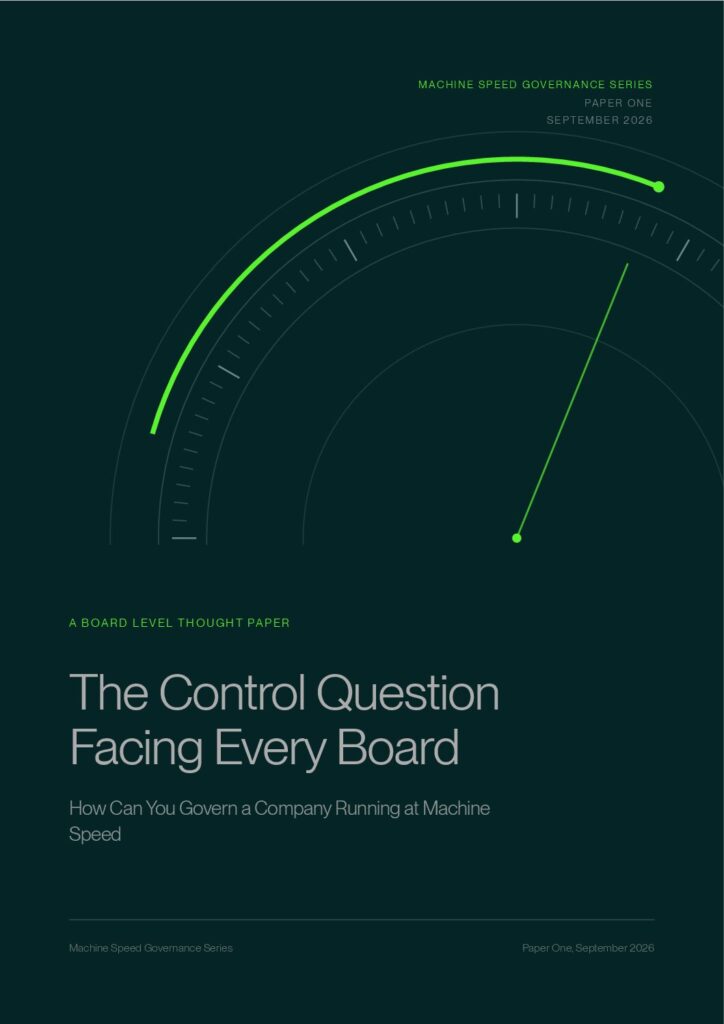
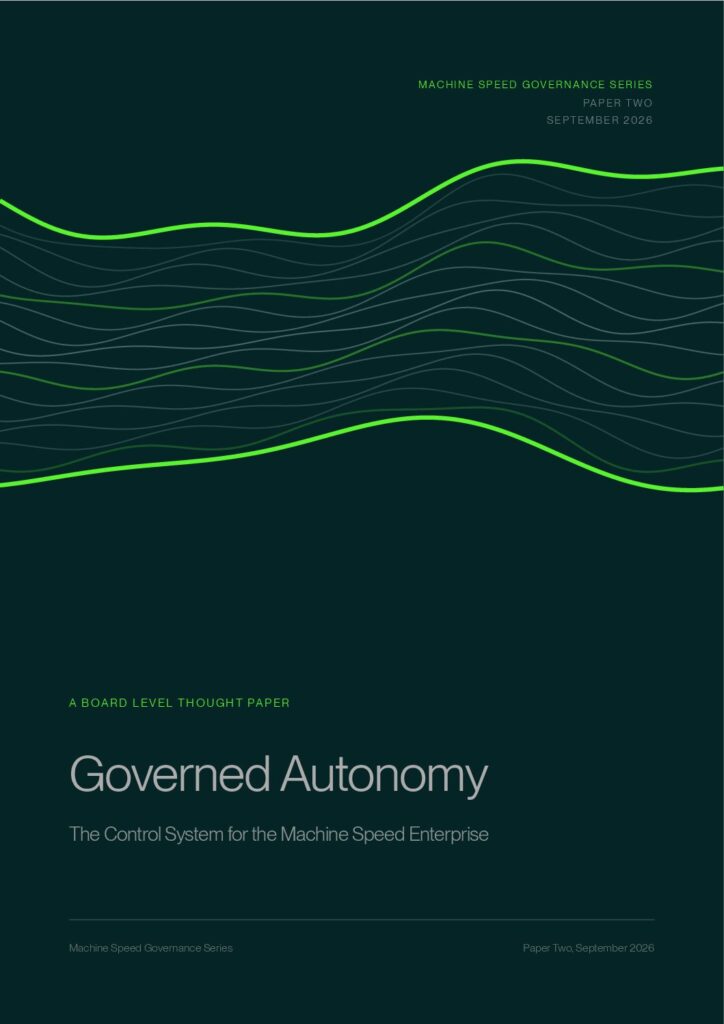
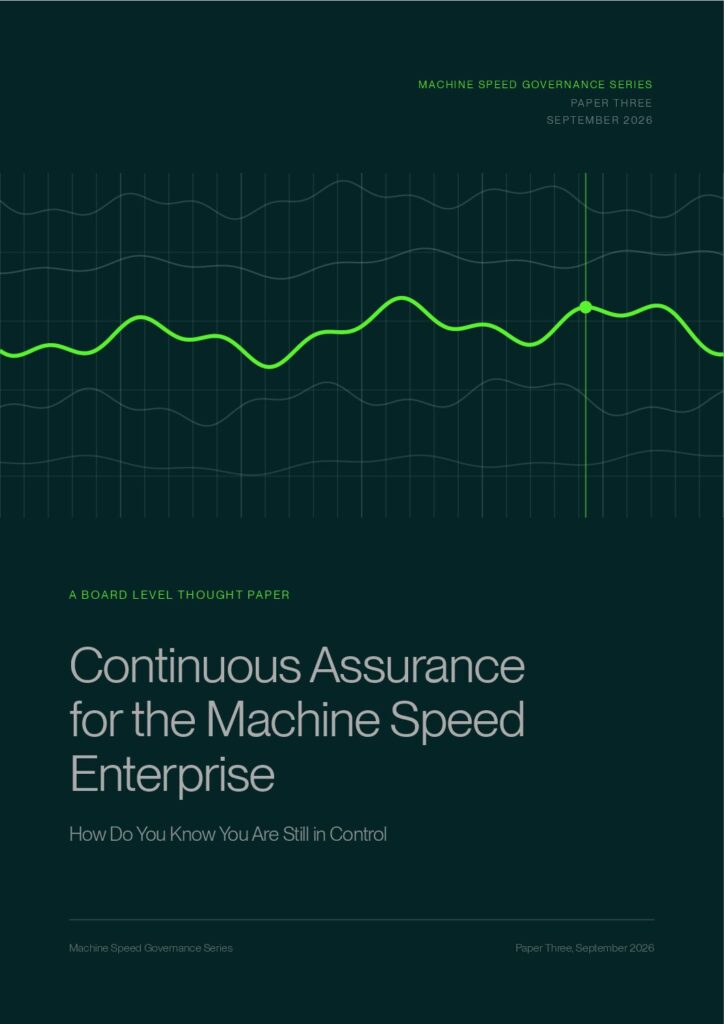
Request all three papers
Fill out the form. All three PDFs open right away, and we will email you the links.
CRISAM® AI Governed Autonomy is an AI governance framework for organizations that let AI make material decisions. Humans define the purpose, the boundaries and the person who can stop a system. Within these boundaries, the AI works at its own pace, and the evidence is generated during live operations.
For organizations that let AI make or prepare material decisions, and for the consultancies, brokers and MGAs that advise, insure or assess them. Each group has its own entry point into the framework.
An AI governance framework defines how an organization stays in control of AI across all systems and frameworks. The CRISAM® framework is based on Governed Autonomy: humans define purpose, authority, boundaries, intervention and accountability, AI acts within these boundaries, and evidence is generated continuously during operations.
The EU AI Act defines what must be done for each individual AI system. The framework defines how an organization stays in control across all AI systems and all regulations, including DORA, NIS2 and the GDPR. Each new obligation is attached to existing records instead of starting a new project.
No. When AI makes thousands of decisions a day, signing off on each one creates delay, not control. The framework requires that every material AI system has a named accountable person who sets its boundaries and can intervene, and that the form of oversight matches what is at stake.
No. AI models, data platforms, monitoring and ticketing stay in place. CRISAM® connects their signals with purpose, risks, obligations, controls, evidence and the person who can intervene.
With three to five material AI decisions, not with all use cases at once. Within 90 days, they are identified, linked to their risks, obligations and controls, monitored and tested, and summarized in a first executive board report.


 Meet CRISAM® at Corporate Risk Minds Europe, stand 4, Hotel Okura Amsterdam, 23 to 24 November.
Learn more
You are currently viewing a placeholder content from Facebook. To access the actual content, click the button below. Please note that doing so will share data with third-party providers.
More InformationYou need to load content from reCAPTCHA to submit the form. Please note that doing so will share data with third-party providers.
More InformationYou are currently viewing a placeholder content from Hubspot Embedded Content. To access the actual content, click the button below. Please note that doing so will share data with third-party providers.
More InformationYou are currently viewing a placeholder content from HubSpot. To access the actual content, click the button below. Please note that doing so will share data with third-party providers.
More InformationYou are currently viewing a placeholder content from Hubspot Meetings. To access the actual content, click the button below. Please note that doing so will share data with third-party providers.
More InformationYou are currently viewing a placeholder content from Instagram. To access the actual content, click the button below. Please note that doing so will share data with third-party providers.
More InformationYou are currently viewing a placeholder content from X. To access the actual content, click the button below. Please note that doing so will share data with third-party providers.
More Information
