A risk assessment becomes more meaningful when each impact is assessed with the method that suits it: financial impacts in monetary terms and, where needed, as a range using a Monte Carlo simulation, and impacts on operations and reputation in qualitative classes. CRISAM® IRM provides qualitative and quantitative assessment methods for this and lets you assess risks at different impact levels. You then bring the results together in the risk matrix. CRISAM® Risk-Flow adds causes and barriers based on the bow-tie method, which gives you a prioritisation you can justify.
A cyberattack costs money, disrupts operations and can damage your reputation. If you assess each of these impacts with the right method, you know not only how big a risk is, but also what matters most about it. This article shows how to do that and how CRISAM® IRM supports you.
Example mapping. Which method you choose for each impact depends on your data and your level of maturity.
How can a risk matrix become more meaningful?
The risk matrix ranks risks by likelihood and impact and shows at a glance which risks need your attention. You can build on this strength: if you do not plot a risk as a single point but assess it by impact, you can see which impact is decisive and where a measure achieves the most.
One point for the cyberattack: you see the size of the risk.
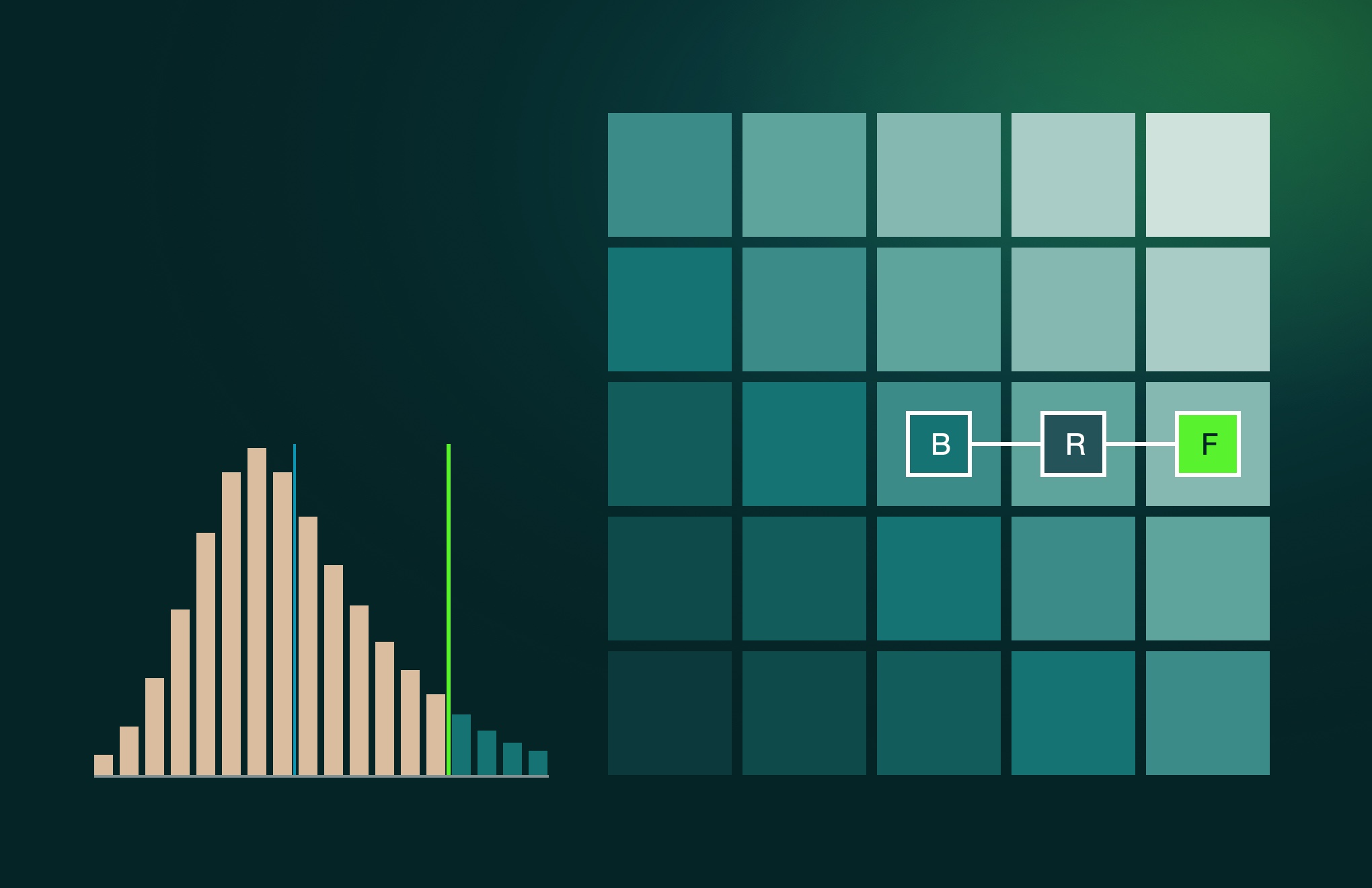
Three points: O for operations, R for reputation, F for finance. The impact that is decisive is marked in green.
Schematic illustration with sample values, not a product view.
This is exactly where CRISAM® IRM comes in: risks can be assessed at different impact levels, which gives management and strategy a reliable basis for decisions. At the CRISAM® Community Talk, the session “Schärfer bewertet” (sharper assessment) presented individually configurable risk matrices for this purpose. They can be set up for each value node or company, with a freely selectable number of classes, and synchronised with the qualitative assessment.
Which assessment method suits which impact?
ISO 31000 describes risk assessment as the overall process of risk identification, risk analysis and risk evaluation, and deliberately leaves the choice of method to you. Its companion standard IEC 31010 provides a whole range of techniques for this, from qualitative rating to simulation. CRISAM® IRM covers this spectrum, so you can start with simple assessment models and develop your risk management step by step all the way to quantitative analyses.
Qualitative assessment: when it is the right choice
Reputational damage or an operational disruption can often be described more accurately in classes than in euros, for example from low to critical. A qualitative assessment is then the right choice, provided the classes are clearly described and everyone involved understands them in the same way. In CRISAM® IRM, wizards guide your business units through the identification and assessment of risks in a structured way.
Monetary assessment: when it pays off
As soon as a decision depends on an amount, for example whether your company can bear a risk or whether a measure pays for itself, a monetary assessment is worthwhile. For this, your business units estimate how high a loss would be and how often it can occur. Because CRISAM® IRM assesses risks from a gross and a net perspective, you also see how effective your measures are.
- ISO 31000
- IEC 31010
- IDW PS 340 n.F.
- ONR 49001
What does a Monte Carlo simulation contribute to risk assessment?
A single expected value says little about how much a loss can vary. A Monte Carlo simulation therefore calculates thousands of possible scenarios and shows the result as a range: you see which loss is to be expected and what you should be prepared for in an unfavourable case.
Schematic illustration without real values.
In CRISAM® IRM, the simulation is integrated. It aggregates your individual risks into an overall picture and, if required, models dependencies between risks using correlations. Key figures such as value at risk and expected shortfall support the analysis of risk-bearing capacity and corporate management.
Your business units do not need statistics expertise for this: they provide their estimate of loss amount and frequency, and CRISAM® derives the appropriate statistical distribution from it. The more carefully these estimates are made, the more reliable the result.
How do you bring the results together in the risk matrix?
If you assess each impact with the right method, you end up with euro amounts alongside qualitative classes. The results become comparable as soon as you translate both into the same classification. The risk matrix is the shared frame for this, showing all impacts in one picture. CRISAM® IRM supports you with individually configurable risk matrices that can be synchronised with the qualitative assessment.
Schematic illustration. You define how amounts and classes map to the levels in your own assessment scheme.
- Separate the impacts
For each risk, record which impacts it has, for example on finance, operations and reputation.
- Choose a method for each impact
Assess financial impacts in monetary terms and all others in qualitative classes that are unambiguous for everyone involved.
- Classify the results
Map amounts and classes to the levels of the risk matrix so that all impacts can be compared side by side.
- Add causes and barriers
Link the assessment to what triggers the risk and what holds it back, and derive your priorities from this.
What does CRISAM® Risk-Flow add with the bow-tie method?
To justify a priority, it matters not only how big a risk is, but also which causes lie behind it and which barriers are already in place. CRISAM® Risk-Flow builds on the bow-tie method and makes causes, barriers and impacts visible at a glance, so that everyone involved can see where gaps remain and where an additional barrier brings the greatest benefit.
Schematic illustration with examples, not a product view of CRISAM® Risk-Flow.
Only when the results are brought together and linked to causes and barriers do you get a prioritisation you can justify.
Would you like to see how individual risks become a reliable overall picture? In the free webinar “Enterprise Risk Management with CRISAM® Monte Carlo Simulation”, Tim-Benjamin Bohmfalk and Andreas Schmitz walk you through the approach in 60 minutes. You will find the upcoming dates on the event page.
Frequently asked questions about risk assessment
It is worthwhile when you want to show financial impacts as a range instead of a single value and aggregate many individual risks into an overall picture, for example to analyse risk-bearing capacity.
No, the two complement each other. The simulation provides the range for financial impacts, and in the risk matrix you place these results alongside the impacts that were assessed qualitatively.
You need an estimate of how high a loss would be and how often it can occur. In CRISAM® IRM, the business units provide this estimate and CRISAM® derives the appropriate statistical distribution from it.
By assessing risks by impact and bringing the results together in the matrix. CRISAM® Risk-Flow adds causes, barriers and impacts at a glance, based on the bow-tie method.
Would you like to get to know us?